Contents
The short answer. Agree extra work and quote changes in writing before they are carried out: request → cost and schedule assessment → approval by both parties → execution. Such a document protects both sides. The client knows the price before deciding, and the contractor knows the work has been ordered. Renovation delays can come from the contractor, the client or outside circumstances. Late client decisions affect the schedule just like a late material delivery, so they should be recorded too.
Key takeaways
- Changes and extra work: in writing and before execution, with a price and the effect on the schedule.
- A good quote already lists items that may change after strip-out.
- The cause of a delay decides how the deadline moves and who bears the consequences.
- Quick client decisions are one of the most effective ways to keep to the schedule.
Why extra work comes up
Extra work does not always mean the quote was poor. Typical reasons:
- Hidden conditions. After strip-out you find damaged pipes, a weak base or wiring that could not be seen on the site visit.
- Client changes. A different tile format, extra sockets, a new shower position or different floors.
- Refined scope. Work marked "to clarify" in the quote becomes specific.
- External circumstances. House rules, access restrictions, the condition of shared elements.
The best prevention is a quote that already names these risk areas — see Renovation estimate example.
Agreeing a change: 5 steps
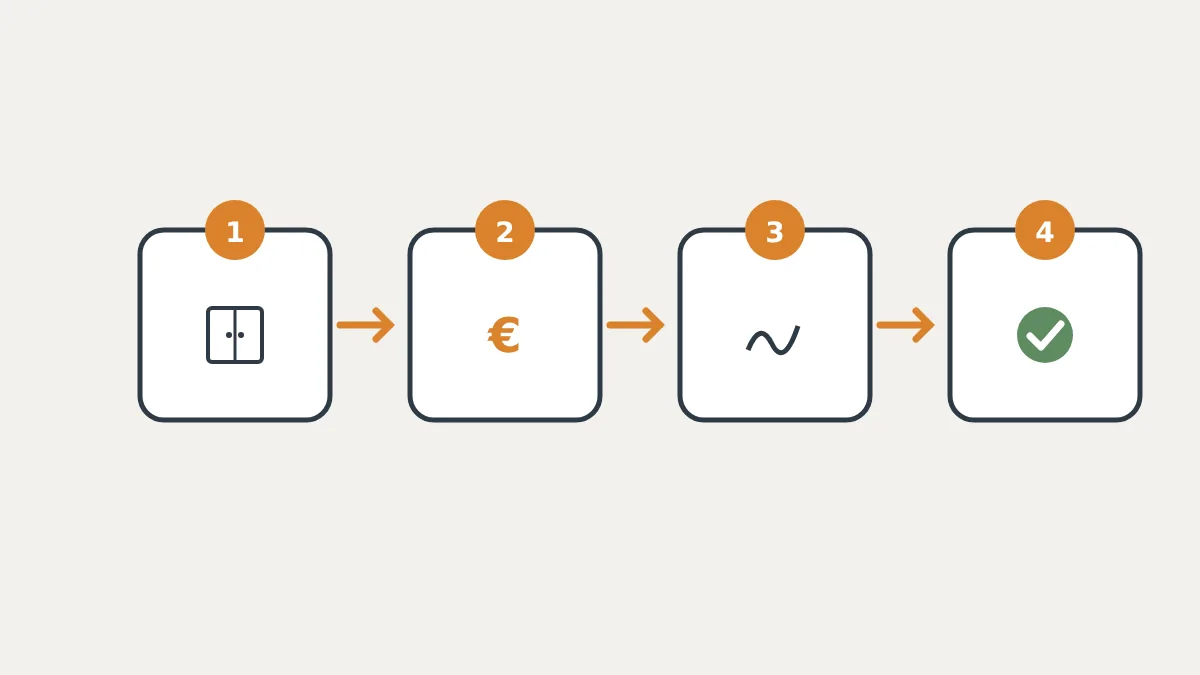
- Request or finding. The client wants a change, or the contractor finds a condition that changes the work. It is recorded in writing — by email, on a change form or as the contract specifies.
- Assessment. The contractor describes the work, quantities, price and effect on the schedule.
- Decision. The client approves, rejects or picks an alternative. If a change is unavoidable (a damaged pipe, say), the options are discussed.
- Approval. Both parties sign the change document or confirm it as the contract provides.
- Execution and record. The work is done and added to the updated quote; change records are kept until handover.
In RigaBuild’s process, changes in scope are documented and the agreed terms rest on the contract. How to compare offers by the way they describe the change procedure is covered in How to choose a renovation contractor in Riga.
What a change order should contain
| Field | Example |
|---|---|
| Date and number | Change No 3, date |
| Reason | Client request / found after strip-out |
| Description of work | What exactly will be done, in which room |
| Quantity and unit | m², pcs, linear metres |
| Price | Amount, and whether VAT is included |
| Materials | Who supplies them, specification |
| Effect on schedule | How many days, or which stage moves |
| Signatures or approval | Both parties |
If a change reduces the scope, the document should also state how much the price goes down.
Delays: contractor, client and external causes
An honest schedule accepts that delays can come from different sides. The table shows how each case is usually handled. The actual consequences are set by your contract.
| Cause | Examples | What usually happens |
|---|---|---|
| Contractor side | Not enough workers, a workmanship error, poor sequencing | The contractor adjusts the schedule and bears the consequences under the contract |
| Client side | Late decisions, materials not delivered on time, no access | The deadline is extended; the change is recorded in writing |
| Hidden conditions | Damage found after strip-out | Assessed; extra work and a new deadline are agreed |
| External | Supplier delay, house rules, emergencies | The other party is informed; a new schedule is agreed |
Latvia’s Civil Law on contracts for work says that if the hindrance to the work arose on the client’s side and the contractor was ready to work, the contractor is still entitled to payment. That payment is reduced if the contractor used the freed-up time for other work (Section 2225). The principle is clear: the cause of a delay matters, so it is worth documenting.
How late decisions move the schedule
Renovation stages follow one another. If the tiles have not been chosen, the tiler cannot start; if the sink position is unknown, the plumbing cannot be finished. One open decision can stop several following stages. RigaBuild’s guidance on timelines stresses that timely decisions on materials and layout matter as much as the pace of work.
In practice:
- □ agree who decides on the client side, and how quickly;
- □ list the decisions needed before each stage;
- □ ask the contractor to flag upcoming decisions in good time;
- □ if a decision is late, record the new deadline in writing.
More on what affects how long a renovation takes in How long does an apartment renovation take.
Want a quote that names the risk items from the start? Request a quote — after a site visit RigaBuild separates out the works that may change after strip-out.
Reducing the risk of extra work
- A thorough site visit before the quote. The more is visible before work starts, the fewer surprises.
- Decisions before work starts. Materials, layout and technical points — ideally before the contract.
- A "to clarify" section in the quote. Better to know the risk areas in advance than discover them mid-job.
- A written procedure. Put into the contract how changes are requested and approved.
- Stage payments. The Civil Law allows payment to be agreed for parts of the work; a contractor can ask for an advance only if it was expressly agreed (Section 2223).
If the total cost turns out much higher than the initial estimate, the Civil Law gives the client the right to withdraw from the contract if the contractor’s preliminary estimate proves too low or the contractor changed the plan without authorisation (Section 2229). This is not a tool for everyday changes, but it shows why changes should always be agreed. After the works, the change records also help at acceptance — see Renovation handover: acceptance and warranty.
Common questions
Questions selected from search data and typical questions; they are not questions from specific clients. Answers are for information only.
How to handle change orders in construction? Record the request in writing, get a priced assessment with the effect on the schedule, approve it before the work is done, and keep the record until handover.
Do you have to accept a change order? No — a change proposed by the contractor is an offer you can approve, reject or replace with an alternative. If it results from an unavoidable condition, discuss the options rather than simply refusing.
Can a contractor request a change order? Yes, when they find a condition that changes the work or when the client’s decision changes the scope. It should be priced and approved before execution.
What happens to the deadline if decisions are late? It is extended by the time needed to decide and carry out the affected stages. Record this in writing.
Sources
- Civillikums. Saistību tiesības — uzņēmuma līgums (Sections 2212–2229) — Saeima (likumi.lv); version in force from 30.03.2026; accessed 26.10.2026.
Services: apartment renovation, major renovation, cosmetic renovation.
Planning a renovation and want a clear change procedure from day one? Request a quote or get a first estimate in the renovation calculator.
Prepared by the RigaBuild editorial team. Prices, timelines and sources checked on 26 October 2026. This article is for information only and does not replace legal advice or a building-board decision.