Contents
The short answer. In a bathroom, the order of works matters more than in any other room: strip-out → plumbing and drainage → electrics → base surfaces → waterproofing → tiling → fitting the sanitaryware. Each stage covers the previous one, so hidden works must be checked before the tiles go on. RigaBuild’s indicative starting price for a bathroom renovation is from €3,000 per project (26 October 2026, excluding VAT, labour only); materials are charged separately.
Key takeaways
- Mistakes in the early stages — connections, floor falls, waterproofing — are hard and expensive to fix later.
- Check and document the hidden works before tiling.
- Moving plumbing points, the condition of the base surfaces, tile format and room geometry drive the price most.
- Choose tiles and sanitaryware before work starts — connection heights depend on them.
Order of works: 7 stages
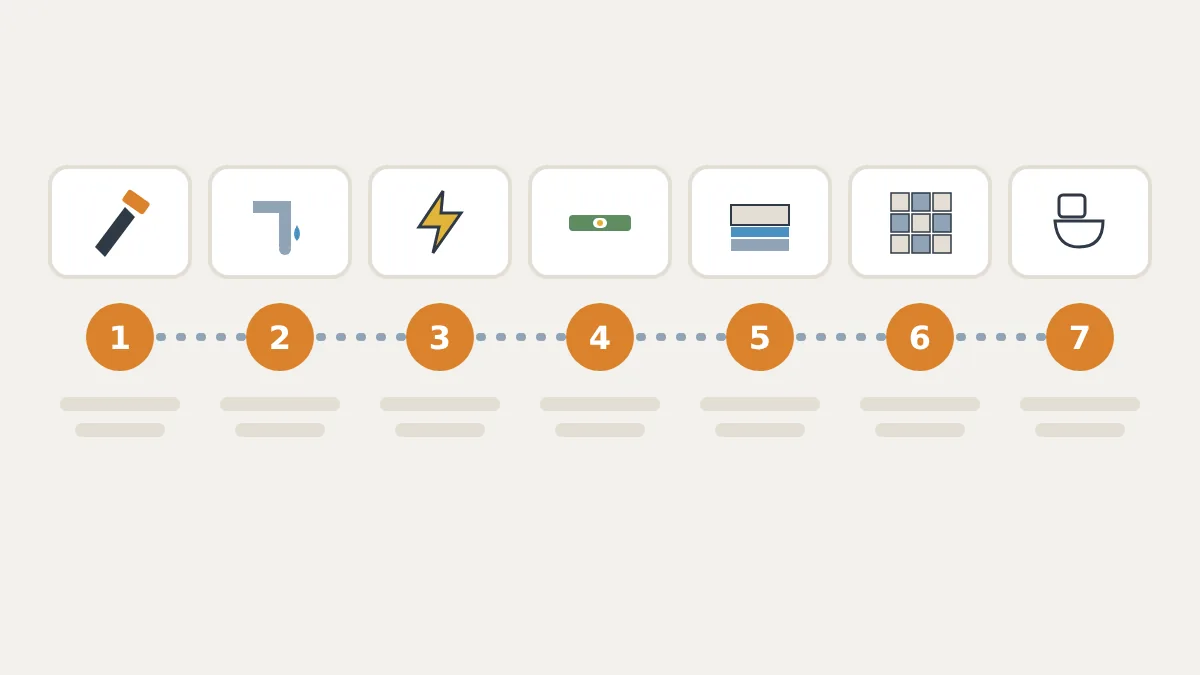
A typical sequence for a full bathroom renovation:
- Strip-out. Old tiles, coverings, sanitaryware and anything not being kept are removed. This is when the real condition of the walls, floor and pipes becomes visible.
- Plumbing and drainage. Water and drain connections are adapted or renewed to suit the layout — shower, basin, WC, washing machine.
- Electrics. Points for lighting, sockets and equipment (for example an extractor fan or heated towel rail) are prepared.
- Base surfaces. Walls and floor are levelled; a floor fall is formed if the shower has no tray.
- Waterproofing. The agreed waterproofing system is installed in the wet zones, with extra care at corners, pipe penetrations and the floor drain.
- Tiling. Walls and floor are tiled to the chosen layout and details.
- Sanitaryware and finishing. Basin, WC, taps and shower screen are fitted; silicone joints and visible details are completed.
Drying and curing times between stages depend on the specific products. They are set by the manufacturer’s instructions and should be respected even when you would like things to move faster.
Hidden works: what to check before tiling
Once the tiles are on, pipes, connections and waterproofing are no longer visible. Before that point, it is worth going through this list with the contractor and photographing the result:
| What to check | Why it matters | How to record it |
|---|---|---|
| Position and height of water and drain outlets | They must match the chosen sanitaryware | Photo with a tape measure, compared with the plan |
| Tightness of joints | A leak behind tiles is found late | Contractor’s check, written note |
| Floor fall to the drain | Water must run off, not stand | Check with a level or water |
| Continuous waterproofing at corners and pipes | Details are the weakest points | Photos before tiling |
| Electrical point positions | Must suit the mirror, cabinets and equipment | Photo and plan |
In construction documentation this is called acceptance of covered works — Latvia’s Construction Law lists a covered-works acceptance certificate among the examples of construction documents. In a flat renovation that needs no building-board procedure it is not a mandatory form, but photos and a short note on the checked details help a lot if questions come up later. For acceptance of the whole job, see Renovation handover: acceptance and warranty.
How to calculate the tiled area
You can work out a first estimate of material and labour quantities yourself. You need the room dimensions and the sizes of the openings.
- Floor: length × width.
- Walls: (2 × length + 2 × width) × tiling height − area of door and window openings.
Example for illustration: a room 2.0 × 1.6 m, walls tiled to 2.4 m, a door opening of 0.8 × 2.0 m. Floor: 2.0 × 1.6 = 3.2 m². Walls: (2 × 2.0 + 2 × 1.6) × 2.4 = 17.28 m², minus the 1.6 m² opening = 15.68 m². Total about 18.9 m² of tiled surface.
Add an allowance for cuts to the material quantity. How much depends on tile format and layout, so agree it with the tiler rather than guessing. RigaBuild’s indicative starting price for tiling works is from €35/m² (excluding VAT, labour), but in a bathroom tiling is usually part of the whole project.
What drives bathroom renovation cost
RigaBuild’s starting price for a bathroom renovation is from €3,000 per project. The final figure depends on specific factors:
| Factor | Effect on the price |
|---|---|
| Room condition | The state of old coverings and base surfaces sets the strip-out and preparation scope |
| Moving plumbing points | Relocated or new connections add technical work |
| Tile size and layout | Format, number of cuts and complex details affect the tiling work |
| Sanitaryware choices | Concealed systems and walk-in showers need more preparation |
| Room geometry | Niches, openings and slopes add finishing detail |
All prices exclude VAT and cover labour. Whether materials are included is set out in the quote. If the bathroom is part of a whole-flat job, see also apartment renovation and the apartment renovation cost guide. For overall renovation timelines, see How long does an apartment renovation take.
Want to know the scope for your bathroom? Request a quote — give the room dimensions, say whether plumbing points will move, and attach a few photos.
Materials to choose early
In a bathroom, material choices affect the technical works, not just the look. Before the plumbing and electrics, you should ideally know:
- □ tile format and layout (they decide the number of cuts and details);
- □ basin, WC and shower solution — concealed or not;
- □ tap type and connection heights;
- □ whether there will be a washing machine, and where;
- □ positions of the mirror, cabinets and lighting.
You can buy the materials yourself or let the contractor source them. If you supply them, note that Latvian law separates responsibility. The Consumer Rights Protection Law says a service is not considered non-conforming if the cause is materials supplied by the consumer. The Civil Law says a contractor is not liable for a poor result caused by the client’s material, unless they knew of its defects and did not warn the client. In practice: agree in writing who checks that materials are suitable before they are installed. More in Renovation materials: who buys them.
Common questions
Questions selected from search data and typical pre-renovation questions; they are not questions from specific clients.
What is a reasonable cost for a bathroom renovation? RigaBuild’s indicative starting price is from €3,000 per project (excluding VAT, labour only, as of 26 October 2026). Materials and sanitaryware come on top. The figure rises when points move, base surfaces are poor or the tiling layout is complex.
What is a realistic budget for a bathroom renovation? Budget three parts separately: labour (from €3,000 per project at RigaBuild), finishing materials, and sanitaryware with taps. Get the labour figure from an itemised quote after a site visit.
Why check waterproofing before tiling? Once the tiles are on, it cannot be seen. Checking and photographing it before tiling is the only way to be sure the corner and pipe details are done properly.
Is a bathroom in a Soviet-era block different? Often yes — shared risers, room size and existing structures shape the options. See Renovating a Soviet-era apartment in Riga.
Sources
- Būvniecības likums (Section 1(4), (9), (14); Section 18(2)) — Saeima (likumi.lv); version in force 01.08.2026–07.01.2027; accessed 26.10.2026.
- Patērētāju tiesību aizsardzības likums (Sections 14.1, 27, 29) — Saeima (likumi.lv); version in force 15.10.2026–19.11.2026; accessed 26.10.2026.
- Civillikums. Saistību tiesības — uzņēmuma līgums (Sections 2212–2229) — Saeima (likumi.lv); version in force from 30.03.2026; accessed 26.10.2026.
Prices: RigaBuild Pricing page and service pages (accessed 26 October 2026).
Planning a bathroom renovation? Get a first estimate in the renovation calculator or request a quote. If you are also doing the kitchen, see Kitchen renovation in Riga: stages and budget.
Prepared by the RigaBuild editorial team. Prices, timelines and sources checked on 26 October 2026. This article is for information only and does not replace legal advice or a building-board decision.